

Forms, Policies & Procedures
 Here you will find a repository of forms, policies and procedures related to research at the University of Delaware. This repository draws on sources throughout campus to provide quick and easy access to these resources in a variety of formats, such as html, MSWord and Adobe PDF. We encourage you to explore and use the tools provided to narrow your search by word, resource type or category in order to learn more about the content that governs research at UD.
*NOTE: As of October 2020 Google Chrome changed how it handles file downloads. If you encounter difficulties, right click on the “Download” button/link and select “save link as.” Once selected the file download will be executed and can be saved to the desktop. A second method is to use a different browser.
Animal Subjects in Research
For Forms, Policies and Procedures pertaining to Animal Subjects in Research and other resources
Compliance
Conflict of Interest
Contracts and Grant Management
Effort Certification
Export Regulations (ITAR/EAR/OFAC)
Human Subjects in Research
Intellectual Property
Internal Funding
Material Transfer
Reporting Misconduct
Research Administration
Research Agreements
Safety
Students
Templates
UD Secure Computing (UDSecCom)
For Policies and Procedures pertaining to the University of Delaware Secure Computing (UDSecCom) and other resources
University
Policy: Research Office
UD Individual Development Plan (IDP)
UD Individual Development Plan (IDP)
University of Delaware IDP policy
The University of Delaware requires Individual Development Plans (IDPs) to be completed for graduate students and postdocs funded by NIH (regardless of funding mechanism) each year. The use of IDPs for all graduate students and postdocs is encouraged as a means for professional development and career planning. Additionally, other funding agencies are beginning to request IDPs.
Reporting
PIs of NIH grants must report on the use of IDPs in their annual Research Progress Performance Report (RPPR) in Section B. Accomplishments, Question B.4. PIs do not need to include actual IDPs; they need to document that graduate students and postdocs funded by the award use IDPs and discuss them with their mentors on an annual basis. Below is suggested wording for inclusion in the RPPR. PIs should modify the text as needed to accurately reflect their activities in encouraging their trainees to develop and utilize IDPs.
The University of Delaware provides a number of resources to support graduate students, postdoctoral fellows and mentors with IDPs. UD recommends that graduate student and postdoctoral researchers utilize “myIDP” provided by AAAS to create and maintain their IDPs. Additional resources for students, postdoctoral fellows, mentors and PIs are available on the University of Delaware website. IDP activity for University of Delaware researchers is tracked in UD’s online IDP reporting system, which maintains privacy of trainees but allows mentors and PIs to monitor IDP-related activities.
Related Links
AAAS “myIDP” Individual Development Planning Tool
UD IDP Assessment Form
Policy Details:
OWNER: Research Office
RESPONSIBLE OFFICE: Research Office
ORIGINATION DATE: December 14, 2015
Policy Source
Email
Form: Research Office
UD Individual Development Plan Assessment Form (IDP Form)
UD Individual Development Plan Assessment Form (IDP Form)
University of Delaware IDP Assessment Form
The University of Delaware requires Individual Development Plans (IDPs) to be completed for graduate students and postdocs funded by NIH (regardless of funding mechanism) each year. The use of IDPs for all graduate students and postdocs is encouraged as a means for professional development and career planning. Additionally, other funding agencies are beginning to request IDPs. To aide in this requirement the UD Research Office is providing an IDP Assessment Form that will help with this effort.
Related Links
AAAS “myIDP” Individual Development Planning Tool
UD Individual Development Plan (IDP) Policy
Form Details:
OWNER: Research Office
RESPONSIBLE OFFICE: Research Office
ORIGINATION DATE: February 25, 2021
Download Form Email
Procedure: Research Office
UD Procedure/Guidance for Preparation of Current and Pending Other Support (CPOS)
UD Procedure/Guidance for Preparation of Current and Pending Other Support (CPOS)
BACKGROUND AND IMPORTANCE
The University of Delaware researchers must be transparent regarding their other research support, other research activities, and research collaborations when submitting grant proposals to external sponsors. Disclosure of such support, known as Current and Pending Other Support (CPOS) allows the identification of potential duplication of funding, assessment of the investigator’s capacity/available effort to complete proposed projects, the evaluation of potential conflicts of interest, and the overall protection of national security and economic interests.
While the format/form being provided to the sponsor may vary, if applicable to a proposal under development, PIs must include ALL support, including grants and contracts from all domestic and non-U.S. sources, including support internal to UD. Additional guidance is generally available in the specific funding opportunity announcement to which the proposal is responding and MUST be followed to avoid return without review or other negative consequences.
Federal agencies are increasingly placing additional scrutiny on potential foreign influence and its impact upon the U.S. research enterprise. Efforts at the federal level are currently underway to standardize disclosure requirements, and some agencies have provided additional guidance on completing disclosure documents. For additional assistance, please contact your departmental administrator.
GENERAL GUIDANCE
Below are some clarifying statements to standardize and set expectations on what to include in CPOS documents submitted by the University of Delaware. Regardless of the sponsor, information provided in CPOS documents must be current, accurate, and complete.
| Tip |
Notes |
| Any activity conducted within the scope of an Investigator’s UD appointment that provides funding or requires a commitment of time must be reported. |
|
| Include all collaborations and affiliations that provide funding or require a commitment of time, whether foreign or domestic. |
|
| Address potential overlap or over-commitments. |
|
| List projects with no-cost extensions. |
|
| Update information as much as possible, e.g., remove outdated proposals or expired awards, unless specifically requested by sponsor. |
|
| For subawards to UD, include the total amount specific to the subaward requested or received by UD. |
|
| Include consulting agreements where the PI or senior/key personnel will be conducting research as part of the consulting activities. |
|
| In-kind contributions should be reported for NIH and NSF, per agency instructions. |
|
| Do NOT include start-up funding from UD. |
|
| Do NOT include consulting agreements that involve non-research consulting activities. |
|
| Do NOT include NIH proposals or projects for which the individual is an Other Significant Contributor. |
|
| Do NOT include UD endowed professorships. |
|
| Do NOT include fee-for-service agreements. |
|
| Do NOT include training awards, prizes, or gifts. |
|
FEDERAL AGENCY GUIDANCE
What follows are examples of Federal sponsor-specific guidance on what they request in their Other Support documents. This guidance is subject to change, so PIs and Departmental personnel are encouraged to consult sponsor instructions directly.
National Institutes of Health (NIH)
NIH defines Current and Pending (Other) Support (CPOS) as “Includes all resources made available to researcher or senior key personnel in support of and/or related to all of their research endeavors, regardless of whether or not they have monetary value and regardless of whether they are based at the institution the researcher identifies for the current grant. Other support does not include training awards, prizes, start-up support from the US based institution, or gifts. (note: Gifts are resources provided where there is no expectation of anything (e.g., time, services, specific research activities, money, etc.) in return)”.
Source: https://grants.nih.gov/grants/policy/nihgps/HTML5/section_1/1.2_definition_of_terms.htm
WHO and WHEN
At Just-in-Time (JIT), all individuals included in the grant application as senior/key personnel MUST submit Current and Pending (Other) Support (CPOS) except:
- Other Significant Contributors
- Program Directors, training faculty and others involved in the oversight of training grants
For Research Performance Progress Reports (RPPR) all senior/key personnel designated in the Notice of Award (NOA) who have had a change in active CPOS since the last reporting period, all new senior/key personnel and all new Other Significant Contributors MUST submit CPOS; do not report on:
- Personnel for whom a PHS 2271 Appointment form has been submitted through xTrain;
- Other Significant Contributors
- Existing Personnel (other than the PD/PI) that worked less than 1 person month on the project.
HOW to disclose
- SciENcv: Science Experts Network Curriculum Vitae – SciENcv: Science Experts Network Curriculum Vitae is an NIH-approved format for use in preparation of the current and pending support section of an NIH proposal. SciENcv will produce NIH-compliant PDF versions of the CPOS format. Supporting documentation, which includes copies of contracts/agreements specific to senior/key-personnel foreign appointments and/or employment with a foreign institution for all foreign activities and resources that are reported in CPOS. If the contracts/agreements are not in English, recipients must provide translated copies.
- Immediate notification of undisclosed CPOS. When a recipient organization discovers that a PI or other Senior/Key personnel on an active NIH grant failed to disclose CPOS information outside of Just-in-Time or the RPPR, as applicable, the recipient must submit updated CPOS to the Grants Management Specialist named in the Notice of Award as soon as it becomes known.
Additional Resources
- Common Forms for Biographical Sketch and Current and Pending (Other) Support Frequently Asked Questions (FAQs)
- Other Support and Foreign Components
- University of Delaware Research Office, Research Security
National Science Foundation (NSF)
The National Science Foundation (NSF) expects that Senior/Key Personnel will list any activity that provides funding to their work and/or a commitment of time by the individual using the Current and Pending section of proposals. NSF also requires that PIs submit information about Collaborators and Other Affiliations (COA) for senior project personnel. This information is in addition to Current and Pending Support, and may include advisor/advisee relationships, coauthors, editorships, business or family relationships that are relevant to peer review.
WHO and WHEN
- At proposal, all Senior/Key Personnel listed on the proposal MUST submit Current & Pending Support, Biosketch, and Collaborators & Other Affiliations documents.
- If an Authorized Organizational Representative discovers that a disclosure should have been made at time of proposal submission, but was not, they have 30 days to submit a post-award request to NSF.
- When submitting annual and final project reports, PIs and Co-PIs MUST specify whether new active other support has been received. If yes, they MUST attach updated Current & Pending Support document(s).
HOW to disclose:
- NSF requires information on all current and pending support for ongoing projects and proposals. Detailed information about the content is available in the Proposal and Award Policies and Procedures Guide (PAPPG), Chapter II.D.2.h.ii..
- SciENcv: Science Experts Network Curriculum Vitae – SciENcv: Science Experts Network Curriculum Vitae is an NSF-approved format for use in preparation of the current and pending support section of an NSF proposal. SciENcv will produce NSF-compliant PDF versions of the current & pending support format.
- Record information for active and pending projects, including the subject proposal.
Additional Resources
- Proposal and Award Policies and Procedures Guide (PAPPG) 24-1
- Documents Required for Senior Personnel
- Pre- and Post-Award Disclosures Relating to the Biographical Sketch and Current & Pending Support.
United States Department of Agriculture (USDA)
WHO and WHEN:
Each project director/principal investigator (PD/PI) and other senior personnel specified in the Request for Applications (RFA). For Agriculture and Food Research Initiative (AFRI) applications, completion of this is only required for PDs/PIs and CoPDs/CoPIs.
At proposal, by uploading an attachment (see Additional Resources below for the recommended template) to the R&R Senior/Key Person Profile (Expanded)
WHAT and HOW to disclose:
- Record information for active and pending projects, including the subject proposal.
- All current efforts to which PD/PI(s) and other senior personnel have committed a portion of their time MUST be listed, whether or not salary for the person involved is included in the budgets of the various projects. For AFRI applications, list only projects for which salary is requested.
- Please check the program solicitation for specific requirements.
Additional Resources
- USDA National Institute of Food and Agriculture (NIFA) Current and Pending Support Form.doc
- USDA NIFA Grants Application Guide
- USDA NIFA Federal Assistance Policy Guide.pdf
National Aeronautics and Space Administration (NASA):
Current and pending (other) support information is used to assess the capacity of senior/key personnel to carry out proposed award activities and helps NASA assess any potential scientific and budgetary overlap or duplication, as well as conflicts of commitment, with the proposed project. Each senior/key person listed on a NASA grant or cooperative agreement proposal is required to submit current and pending support disclosures with their application.
WHO and WHEN
NASA designates as a senior/key person all Principal Investigators (PIs), all co-Principal Investigators (CoPIs), and co-Investigators (Co-Is) proposing to spend 10 percent or more of their time in any given year on a NASA-funded grant or cooperative agreement. Refer to Notice of Funding Opportunity (NOFO) if any other personnel categories are designated as Senior/Key Personnel. Proposals do not need to include the current proposal on the list of pending proposals unless it has been submitted in response to another funding opportunity (i.e., NASA or another sponsor).
At proposal, included in the submission packet.
WHAT and HOW
NASA has provided a table of Pre-Award and Post-Award Disclosure Requirements
- PIs and Co-PIs also shall list any current and pending support with China, including Chinese universities and other similar institutions or a Chinese-owned company at the prime recipient level and at all subrecipient levels, whether the bilateral involvement is funded or performed under a no-exchange of funds arrangement. (NASA Proposer’s Guide, 2.16)
Additional Resources
- NASA current-and-pending-support-cps-form.docx
- NASA Pre-Award and Post-Award Disclosure Requirements.
- NASA Grant and Cooperative Agreement Manual
Department of Energy (DOE)
Current and pending support is intended to allow the identification of potential duplication, overcommitment, potential conflicts of interest or commitment, and all other sources of support. All senior/key personnel at the recipient and subrecipient level must provide a list of all sponsored activities, awards, and appointments, whether paid or unpaid; provided as a gift with terms or conditions or provided as a gift without terms or conditions; full-time, part-time, or voluntary; faculty, visiting, adjunct, or honorary; cash or in-kind; foreign or domestic; governmental or private-sector; directly supporting the individual’s research or indirectly supporting the individual by supporting students, research staff, space, equipment, or other research expenses. All senior/key personnel involved in the project must disclose all other foreign or domestic government or non-profit support of the work to be done under the award. All involvement with foreign government-sponsored talent recruitment programs must be identified in current and pending support.
WHO:
All Senior/key personnel. DOE defines Senior/key personnel as: “An individual who contributes in a substantive, meaningful way to the scientific development or execution of a Research, Development and Demonstration (RD&D) project proposed to be carried out with a DOE award.” DOE clarifies that typically these individuals have a doctoral or other professional degree, although individuals with other levels of education/experience may be considered Senior/key if their involvement meets the above DOE definition.
Other covered individuals. At the award negotiation stage or during the performance of an award, DOE may designate project personnel as Senior/key and require their Current and Pending Support form. This could include consultants, postdocs, graduate students, etc.
WHEN to disclose:
- Proposal stage: Follow the instructions provided in the Funding Opportunity Announcement for your proposal submission.
- Award stage:
- Adding new Senior/key personnel – If there are changes or additions to Senior/key personnel for the project, the new person MUST submit a Current and Pending Support form within 30 days of joining the project team, or on a timeline provided by the program office.
- Changes to previously submitted Current and Pending Support – Changes to a previously submitted Current and Pending Support form MUST be submitted within 30 days of the change, or on a timeline provided by the program office.
HOW to disclose:
- DOE uses NSF’s Current and Pending Support format, which can be completed through SciENcv, or the PDF template
- Please check the program solicitation for specific requirements.
Department of Defense (DOD)
Provide support information for the PI and all senior/key personnel, including other individuals who will contribute to the scientific development or execution of the proposed research project in a substantive, meaningful way, independent of whether they request salaries or compensation. Compensation could take many forms including cash, research funding, complimentary foreign travel, honorific titles, career advancement opportunities, promised future compensation, or other types of remuneration or consideration, including in-kind compensation. Include the total or estimated dollar amount for research, resource, or other project support.
WHO:
Required for all key personnel at the proposal stage.
Outside of DoD CDMRP solicitations, individual DoD funding opportunity announcements (FOAs)/solicitations have varied disclosure requirements. always review carefully and follow the disclosure guidance in the specific DoD solicitation to which you/your investigator is applying.
HOW to disclose:
This information shall be included in the Senior Key Person Profile form included in the Notice of Funding Opportunity (NOFO) and will not be included in the overall proposal page limits.
Please check the program solicitation. However, CDMRP general instructions can be found under IV.B.d. of the General Application Instructions 901.pdf
Procedure Details:
OWNER: Research Office
RESPONSIBLE OFFICE: Research Office
ORIGINATION DATE: May 24, 2021
REVISION DATE(S): 1/10/2022, 1/19/2022, 10/01/2025
Procedure Source Email
Procedure: Research Office
UD Service Maintenance Contract Procedure Advance Payment on Sponsored Projects Internal Guidance
UD Service Maintenance Contract Procedure Advance Payment on Sponsored Projects Internal Guidance
Service/maintenance contracts on sponsored projects are agreements with a vendor to perform services to ensure the equipment’s satisfactory operation during the life of a sponsored project. There are two types of payment options for service/maintenance contracts: advance payment or a payment schedule. This guidance addresses advance payments for equipment contracts.
Advance payment can be advantageous if the vendor offers a significant discount for early payment. The vendor may also require advance payment. Advance payment requires documentation to support why this payment option is required and/or necessary.
If it is determined that advance payment is the optimal course, it must be reasonable, allowable, allocable, and applicable to the sponsored project. To confirm this, the following questions should be considered:
1) Was the associated piece of equipment charged to the project?
2) Is the service/maintenance contract important, necessary, critical, or vital to the
continued operation of the equipment?
3) What are the implications to the sponsored project if the service/maintenance
contract is forfeited?
To be in compliance with Uniform Guidance – Subpart D, E, & F, this documentation should be included in the UD Exchange (UDX) requisition request. A document may be attached, or a comment can be included on the requisition (for example):
“This contract is vital to the project due to [INSERT EXPLANATION]. Research
would halt with any delay due to equipment malfunction because [INSERT
EQUIPMENT NAME] is necessary and integral to project to [INSERT EXPLANATION].”
If the vendor requires advance payment, and there were no other qualified vendor options, please add a note to UDX regarding that. After determining the service / maintenance contract is essential to the project, appropriate allocation of the cost can be managed according to the term of the contract:
1) Contracts covering twelve months or less; or
2) Multi-year contracts covering more than twelve months.
Contracts covering twelve months or less
Service/maintenance contracts that cover twelve months or less can be charged directly to the sponsored project within the same budget period as paid.
Multi-year service/maintenance contracts covering more than twelve months
Multi-year service/maintenance contracts on sponsored projects are allowable. In the event of a multi-year contract, it is recommended, if possible, to seek quarterly or annual payment.
1) If a multi-year contract is advantageous to the project, the justification (cost, service level, etc.) must be provided in UDX for review and approval by the Research Office. The period approved will be allowable to the sponsored project as paid.
2) For multi-year contracts which are disallowed to be charged to the project under (1) above, the first-year costs may be allocated to the sponsored project as paid, while subsequent years must be allocated to a departmental non-sponsored source of funding. Subsequent year costs may be reallocated to the allocable sponsored project within each budget period corresponding to the service/maintenance contract as paid.
Cost allocation to the sponsor code will be as paid.
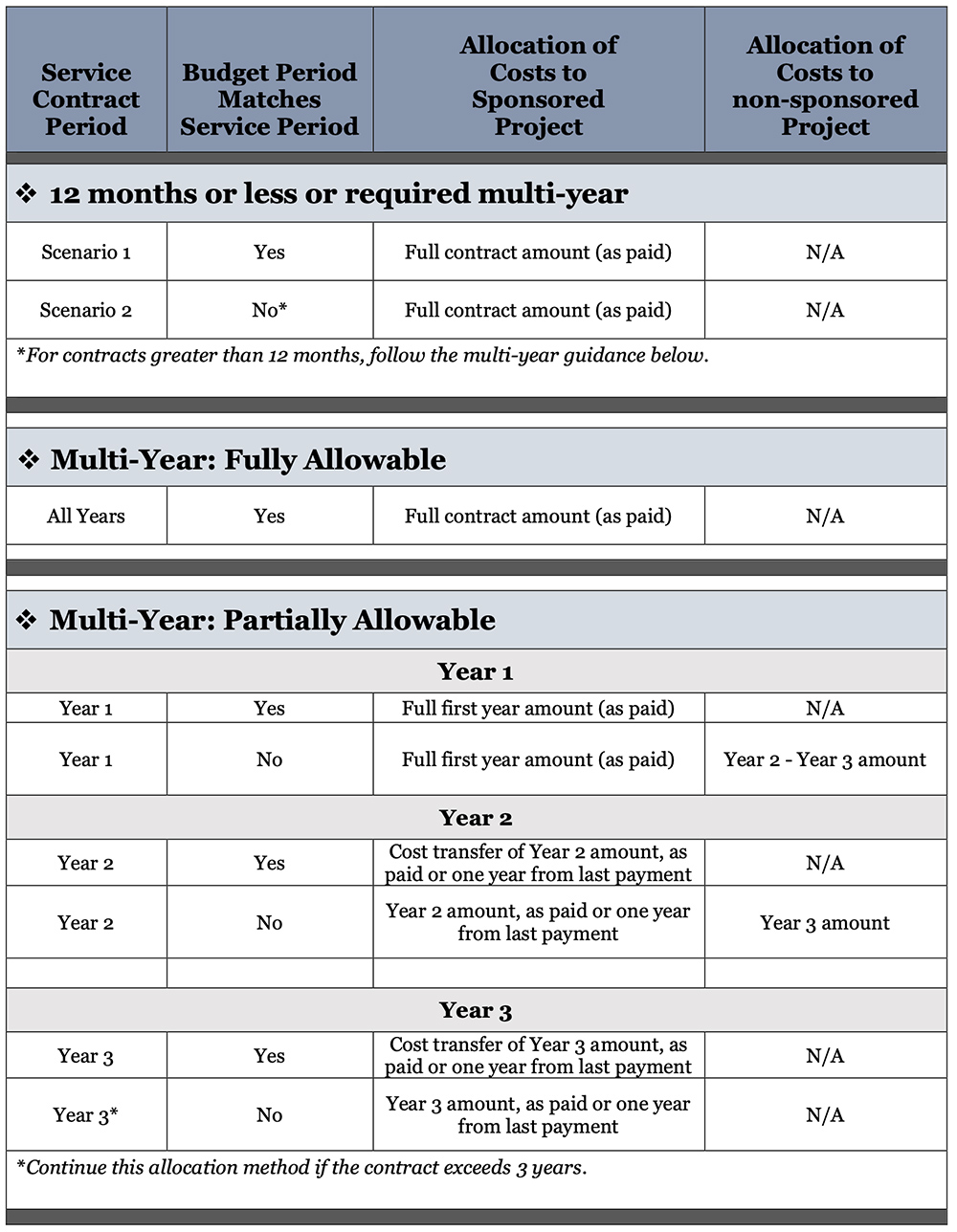
Example Scenarios
Example 1 – Twelve-month contract or less
Invoice received: 03/12/2023
Federal Award: 9021086936
Award period: 03/01/2021-08/31/2025
Maintenance contract period: 04/01/2023-03/31/2024
Annual Maintenance Total: $18,500.00
Accounting: $18,500.00 to award in March 2023 (when invoice received)
Sticking with the main example above, except changing the what ifs below:
What if: invoice received 06/01/2023 and contract period was 06/01/2023-05/31/2024.
Accounting: charge $18,500.00 to award in June 2023
What if: invoice received 06/01/2023 and contract period was 06/25/2023-05/24/2024.
Accounting: charge $18,500.00 to award in June 2023
What if: invoice received 10/01/2024 and contract period was 10/01/2024-09/30/2025.
Accounting: charge 11/12ths of $18,500 to award in October 2024 (award ends 08/31/2025)
Example 2 – Multi-year contract
Invoice received: 05/12/2023
Federal Award: 5021086639
Award period: 07/01/2022-06/30/2026
Maintenance contract period:
Year 1: 04/17/2023- 04/16/2024; $75,250.25
Year 2: 04/17/2024- 04/16/2025; $79,440.48
Year 3: 04/17/2025- 04/16/2026; $80,996.75
Annual Maintenance Total: $235,687.48
Example 2: Accounting- if allowed in full:
Charge full contract amount, $235,687.48, to award in May 2023 (when invoice received) (Allowed in full: justification provided for vital criteria/implications to sponsored project)
Example 2: Accounting- if disallowed in full:
Charge Year 1, $75,250.25 to award in May 2023 (when invoice received)
Charge Years 2-3 total, $160,437.23 to a department discretionary code in May 2023 (when invoice received)
Note: with multi-year contracts, the out years charge must be allocated to a department discretionary purpose code and reallocated to the award yearly corresponding to the service contract year making sure it falls within the award period.
Procedure Details:
OWNER: Research Office
RESPONSIBLE OFFICE: Research Administration
ORIGINATION DATE: July 21, 2023
Procedure Source Email
Form: Research Office
UDRF Final Report Template
UDRF Final Report Template
The University requires that a report on the project be submitted to the Research Office no later than 90 days after the end of the grant.
This form serves as a template for the Final Report on GUR and UDRF Grants. Completion of this form affects eligibility for future internally funded grants.
For more info contact
The Research Development Office
researchdev@udel.edu
(302) 831-2136
Form Details:
OWNER: Research Office
RESPONSIBLE OFFICE: Research Office
ORIGINATION DATE: March 1, 2016
Download Form Email
Form: Research Office
UDRF-SI Final Report Template
UDRF-SI Final Report Template
The University requires that a report on the project be submitted to the Research Office no later than 90 days after the end of the grant.
This form serves as a template for the Final Report on GUR and UDRF Grants. Completion of this form affects eligibility for future internally funded grants.
For more info contact
The Research Development Office
researchdev@udel.edu
(302) 831-2136
Form Details:
OWNER: Research Office
RESPONSIBLE OFFICE: Research Office
ORIGINATION DATE: August 11, 2016
Download Form Email
Policy: Safety
Underground Storage Tank Management
Underground Storage Tank Management
- SCOPE OF PURPOSE
To ensure the management of Underground Storage Tanks (USTs) at the University is conducted in compliance with Federal and State Underground Storage Tank Regulations (7 Del. Code Chapter 74, 40CFR280), NFPA, BOCA, City of Newark and other applicable codes.This policy applies to all University underground storage tanks and underground storage tank systems containing motor fuels, heating oils, waste products, and other regulated products. …
The complete policy and more can be found on the ’s web site.
Policy Details:
OWNER: Executive Vice President
SECTION: Campus Safety and Security Policies
RESPONSIBLE OFFICE: Office of Environmental Health and Safety
POLICY NUMBER (Legacy): Jul-39
ORIGINATION DATE: February 28, 1989
REVISION DATE(S): April 1, 1996; January 12, 2006
Policy Source
Email
Form: Research Office
Uniform Biological Material Transfer Agreement
Uniform Biological Material Transfer Agreement
In 1995, the National Institutes of Health (NIH) published the Uniform Biological Material Transfer Agreement (UBMTA) and an Implementing Letter for the transfer of materials between nonprofit institutions. The University of Delaware is one of the institutions which has signed the UBMTA which allows signatory institutions to transfer materials to one another using a boilerplate Implementing Letter for the particular transfer.
Use of the UBMTA is optional, UD researchers may opt to use the Non-Biologicals form as an alternative. Note that the UBMTA Letter must accompany the UBMTA in all cases. Please provide investigator/scientist information as appropriate and sign as recipient or provider. Attach the completed UBMTA to the Webform before submitting.
Related Links
• Material Transfer Agreement Required Webform
• Material Transfer Agreement Template – Incoming
• Material Transfer Agreement Template – Outgoing
• Uniform Biological Material Transfer Agreement
• Uniform Biological Material Transfer Agreement Implementation Letter
Form Details:
OWNER: Research Office
RESPONSIBLE OFFICE: Research Office
ORIGINATION DATE: November 15, 2013
Download Form Email
Form: Research Office
Uniform Biological Material Transfer Agreement Implementation Letter
Uniform Biological Material Transfer Agreement Implementation Letter
The UBMTA Letter must be used in conjunction with the UBMTA. The Implementing Letter contains a description of the material and a statement indicating that the material is being transferred in accordance with the terms of the UMBTA. It must be executed by the provider scientist and the recipient scientist, and is subject to UD Research Office approvals. Please complete the highlighted sections of the form and sign as provider or receiver as appropriate. Attached the completed UBMTA Letter to the Webform before submitting.
Related Links
• Material Transfer Agreement Required Webform
• Material Transfer Agreement Template – Incoming
• Material Transfer Agreement Template – Outgoing
• Uniform Biological Material Transfer Agreement
• Uniform Biological Material Transfer Agreement Implementation Letter
Form Details:
OWNER: Research Office
RESPONSIBLE OFFICE: Research Office
ORIGINATION DATE: December 10, 2013
Download Form Email
Policy: Research Office
Uniform Guidance Procurement Standards Update
Uniform Guidance Procurement Standards Update
MEMO
July 9, 2018
Re: Uniform Guidance Procurement Standards Update
Dear Colleagues,
We would like to update you of Policy changes regarding procurement of goods and services in accordance with the federal government’s Office of Management and Budget (OMB) Uniform Guidance. OMB has recently issued a memorandum that raises the threshold for micro-purchase under Federal financial assistance awards to $10,000, and raises the threshold for simplified acquisitions (large purchases) to $250,000. The University has revised the Procurement Policy 5-01, effective July 1, 2018, accordingly and as follows:
- The following quotation/bid thresholds apply:
- Federal Contracts and Grants including Mandatory/Voluntary Committed Cost Share and University Service Centers:
- Less than $10,000 – Departments should perform due diligence on pricing options to ensure that products or services are obtained at reasonable prices.
- $10,000 to $250,000 – Quotes must be obtained from an adequate number of qualified sources (minimum of three sources if available). If there is only one qualified source, a UD Sole Source Justification form must be completed and submitted to Procurement for review and approval.
http://www1.udel.edu/procurement/forms/Sole-Source-Form-UD.docx - $250,000 and greater – Sealed bids are required with formal advertising by Procurement Services unless there is only one qualified source. A UD Sole Source Justification form must be completed and submitted to Procurement for review and approval.
http://www1.udel.edu/procurement/forms/Sole-Source-Form-UD.docx
- All Other purchases:
- Up to $50,000, solicitation of quotations/bids will be at the discretion of Procurement Services. Buyers in Procurement Services are accountable for exercising professional due diligence by soliciting written or telephone quotations (documented) when appropriate.
- Purchases over $50,000 require price quotations or sealed bids to be obtained from at least three qualified vendors (if available), solicited by Procurement Services.
- In the event that only a single source can be located for a particular purchase exceeding $50,000, Procurement Services will make that determination and the buyer will so document in the purchasing system.
- Federal Contracts and Grants including Mandatory/Voluntary Committed Cost Share and University Service Centers:
Thank you for your cooperation and effort in this regard. Please contact Procurement Services with any questions.
The complete policy and more can be found on the UD Research Office’s web site.
Policy Details:
OWNER: Research Office
RESPONSIBLE OFFICE: VP of Finance / Research Office
ORIGINATION DATE: July 9, 2018
Policy Source
Email
Policy: University
University of Delaware Research Foundation Program
University of Delaware Research Foundation Program
- PURPOSE
To outline the administration, type of research supported, and application procedures for grants awarded by the University of Delaware Research Foundation. - POLICY
- University of Delaware Research Foundation ProgramThe University of Delaware Research Foundation, Inc. is a nonprofit, tax-exempt organization for the support of fundamental research in all fields of science. An independent corporation, it is chartered primarily to support the University’s scientific research programs.
University of Delaware Research Foundation (UDRF) grants are administered by the Senior Vice Provost for Research, who represents the University on the UDRF Research Committee and is secretary of the UDRF Board of Trustees.
The Senior Vice Provost for Research disseminates the updated information on UDRF grants to the faculty annually by letter. This letter includes the deadline for applications for grants.
The appropriate deans and chairs provide the Senior Vice Provost for Research with preliminary evaluations of applications for grants. The Senior Vice Provost combines these evaluations into a University recommendation. The final evaluation and award decision is made by the UDRF Research Committee. Grants are made primarily in the fields of the natural and physical sciences, but any proposal that uses scientific methods and promises quantitative results is eligible for a grant.
- GrantsUDRF grants support high quality scientific and engineering projects by early-career, untenured, tenure-track faculty. Costs covered are stipends, graduate student or technical assistance, equipment, supplies, travel, etc. Grants are awarded on the basis of individual merit and specific need.
The awards are made in April and become effective on the following June 1.
These grants are not to be used for the support of advanced-degree theses nor for their publication.
Understandings concerning the research grant programs and patents, copyright, and publishing considerations are stated in the Faculty Handbook and in this Policies and Procedures Manual.
Patent, copyright, and publication policies are as stated in the University of Delaware Faculty Handbook and in sections 6-6 and 6-7 of this Policies and Procedures Manual.
- Understandings and Procedures for Submitting Proposals are found in the UDRF Proposal Guidelines which are updated annually by the committee.
- University of Delaware Research Foundation ProgramThe University of Delaware Research Foundation, Inc. is a nonprofit, tax-exempt organization for the support of fundamental research in all fields of science. An independent corporation, it is chartered primarily to support the University’s scientific research programs.
The complete policy and more can be found on the ’s web site.
Policy Details:
OWNER: Provost
SECTION: Research, Sponsored Program, Technology Transfer and Intellectual Property Policies
RESPONSIBLE OFFICE: UD Research Office
POLICY NUMBER (Legacy): 2-Jun
ORIGINATION DATE: October 1, 1981
REVISION DATE(S): June 5, 1989; March 1, 1996; September 1, 2005; January 18, 2008; August 6, 2008
Policy Source
Email
Policy: Export Regulations (ITAR/EAR/OFAC)
University Procedure for International Travel with Electronic Devices
University Procedure for International Travel with Electronic Devices
The purpose of this memorandum is to remind and inform University of Delaware (UD) employees of the states-of-nature and UD expectations that exist when traveling internationally with mobile devices, laptop computers, personal-digital assistants (PDAs) and other electronic devices.
Consistent with the guidelines offered by the Office of the Director of National Intelligence, U.S. National Counterintelligence & Security Center (NC&SC) (https://www.dni.gov/index.php/ncsc-home), University personnel who are traveling internationally should be aware that:
- In most countries, travelers should have no expectation of privacy in internet cafes, hotels, offices or public places. Hotel business centers and telephone networks are regularly monitored in many countries. In some countries, hotel rooms are often searched.
- All information that you send electronically by FAX machine, PDA, computer or telephone can be intercepted. Wireless devices are especially vulnerable.
- Your movements can be tracked using your mobile telephone or PDA, and the microphone in your device can be turned on even when you think that it is turned off. To prevent this, remove the battery.
- Malicious software can be inserted into your electronic device through connections you use. This can also be done if your device is enabled for wireless. When you connect to your home server, the malware can migrate to your home system and/or the University, can inventory your system, and can send information back to the individuals who inserted the software.
- Malware can be transferred to your device through thumb drives (Universal-Serial Bus (USB) sticks), computer disks … some of which you may have been given as “gifts”.
- Transmitting sensitive information from abroad is risky
- While corporate or government officials may be most at risk, it incorrect to assume that you will not be targeted.
- Intruders are skilled at posing as someone you trust in order to obtain personal or sensitive information (i.e., phishing).
- If customs officials demand to examine your device, or if your hotel room is searched while your device is unattended in the room, you should assume your device has been compromised.
To mitigate these threats, again consistent with NC&SC guidelines, when traveling internationally, University personnel should:
- Take only necessary devices.
- Take only needed information, including sensitive contact information. Consider the consequences if your information were stolen or otherwise compromised.
- Back up all information you take, and leave the backed-up information at home.
- If feasible, use a different mobile telephone or PDA from your usual one, and remove the battery when not in use. Have your device examined by your UD information technology (IT) support-personnel when you return.
- Monitor official cyber security alerts from https://www.consumer.ftc.gov/features/feature-0038-onguardonline.
- Creating a strong password (numbers, upper and lower case letters, special characters – at least eight characters long). Never storing passwords, telephone numbers, or sign-on sequences on any device or in its case.
- Changing passwords at regular intervals, and as soon as you return.
- Downloading current, up-to-date antivirus protection, spyware protection, operating system security patches, and a personal firewall.
- Encrypting all sensitive information on a device. (Note that in some countries, customs officials may not permit you to enter with encrypted information.)
- Updating your web browser with strict security settings.
- Disabling infrared ports and features you don’t need.
While travelling internationally, you should:
-
- Avoid transporting devices in checked baggage.
- Use a digital signature and encryption when possible.
- Don’t leave your electronic devices unattended. If you stow a device, remove the battery and subscriber-identity module (SIM) card, and keep them with you.
- Don’t use thumb drives given to you – they may be compromised. Similarly, don’t use your own thumb drive in a foreign computer. If you must do either, assume your device has been compromised, and have it cleaned as soon as possible.
- Shield passwords from view. Don’t use the “remember me” feature that is found on many websites … retype the password every time.
- Be aware of who is looking at your screen, especially in public places.
- Terminate connections when you are not using them.
- Clear your browser after each use, delete history files, caches, cookies, URL and temporary internet file.
- Do not open emails or attachments from unknown sources. Don’t click on links in emails. Empty your “trash” and “recent” folders after every use.
- Avoid Wi-Fi networks. They are insecure, and maybe controlled.
- If your device or information is stolen, report it immediately to UD and the local US embassy or consulate.
Upon your return from international travel, you should:
-
-
- Change your password.
- Have your UD IT support-personnel examine your device for the presence of malicious software, if you suspect that it may have been compromised.
-
If you have questions, contact the Research Office at UDResearch@udel.edu or (302) 831- 2383. Additional information regarding “Travel Best Practices for Both Domestic & Abroad” is provided by UD Information Technologies at https://www.udel.edu/it/security/bestpractices/travel.html.
The complete policy and more can be found on the ’s web site.
Policy Details:
OWNER: UD Research Regulatory Affairs
RESPONSIBLE OFFICE: Research Office
ORIGINATION DATE: January 1, 2016
Policy Source
Email