
 Research & Discovery
A Blog Devoted to UD Innovation, Excellence and Scholarship

Research & Discovery
A Blog Devoted to UD Innovation, Excellence and Scholarship
Quantum Momentum
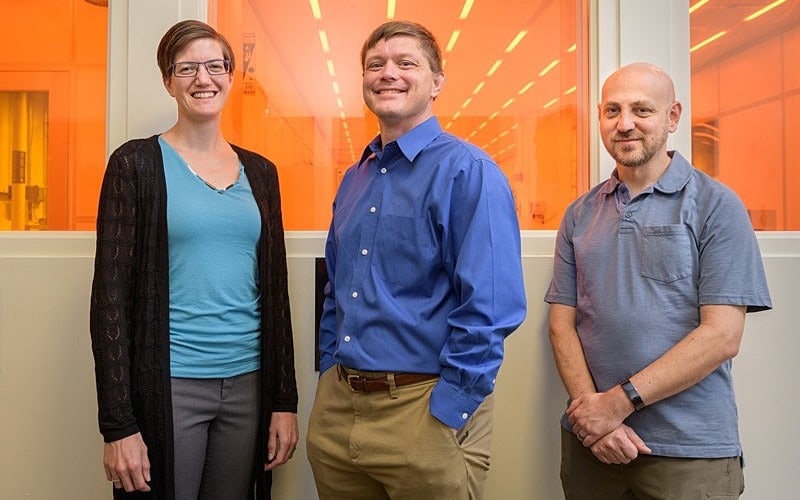
ABOVE: As part of a National Science Foundation initiative to advance the quantum technology revolution, University of Delaware researchers will explore a new approach to making quantum devices, 10,000 times smaller than the width of a human hair, in UD’s Nanofabrication Facility, shown behind them. Project leader Matthew Doty (center) is flanked by team members Stephanie Law and Joshua Zide. All are professors in UD’s Department of Materials Science and Engineering. | Photo by Evan Krape
UD team gets $1 million from NSF to help research quantum technology
A technology revolution is coming, and the University of Delaware is on the leading edge as the recipient of a $1 million grant from the National Science Foundation to help develop the quantum electronics of the future. The funding is part of $31 million in quantum research projects announced Sept. 24 by NSF Director France Córdova at a White House summit on quantum information science.
“The quantum revolution is about expanding the definition of what’s possible for the technology of tomorrow,” Córdova said. “NSF-supported researchers are working to deepen our understanding of quantum mechanics and apply that knowledge to create world-changing applications. These new investments will position the U.S. to be a global leader in quantum research and development and help train the next generation of quantum researchers.”
Many of today’s technologies rely on the interaction of matter and energy at extremely small length scales. Quantum mechanics studies nature on such a scale — many thousands of times smaller than the width of a human hair — allowing researchers to observe, manipulate and control the behavior of particles. Next-generation technologies for communication, computing and sensing will exploit these interactions with potentially profound benefits.
“The power of quantum science is that it offers totally new ways to develop electronic devices — from computers to medical sensors — with the promise of processing information faster and with greater accuracy and security than ever before,” said Matthew Doty, associate professor in UD’s Department of Materials Science and Engineering and lead investigator on the project.
UD Research on Twitter