

Forms, Policies & Procedures
 Here you will find a repository of forms, policies and procedures related to research at the University of Delaware. This repository draws on sources throughout campus to provide quick and easy access to these resources in a variety of formats, such as html, MSWord and Adobe PDF. We encourage you to explore and use the tools provided to narrow your search by word, resource type or category in order to learn more about the content that governs research at UD.
*NOTE: As of October 2020 Google Chrome changed how it handles file downloads. If you encounter difficulties, right click on the “Download” button/link and select “save link as.” Once selected the file download will be executed and can be saved to the desktop. A second method is to use a different browser.
Animal Subjects in Research
For Forms, Policies and Procedures pertaining to Animal Subjects in Research and other resources
Compliance
Conflict of Interest
Contracts and Grant Management
Effort Certification
Export Regulations (ITAR/EAR/OFAC)
Human Subjects in Research
Intellectual Property
Internal Funding
Material Transfer
Reporting Misconduct
Research Administration
Research Agreements
Safety
Students
Templates
UD Secure Computing (UDSecCom)
For Policies and Procedures pertaining to the University of Delaware Secure Computing (UDSecCom) and other resources
University
Procedure: U.S. Department of State
The International Traffic in Arms Regulations (ITAR)
The International Traffic in Arms Regulations (ITAR)
The Department of State is responsible for the export and temporary import of defense articles and services governed by 22 U.S.C. 2778 of the Arms Export Control Act (“AECA”; see the AECA Web page) and Executive Order 13637. The International Traffic in Arms Regulations (“ITAR,” 22 CFR 120-130) implements the AECA. The ITAR is available from the Government Printing Office (GPO) as an annual hardcopy or e-document publication as part of the Code of Federal Regulations (CFR) and as an updated e-document.
Procedure Details:
OWNER: Department of State
RESPONSIBLE OFFICE: Research Office
Procedure Source
Email
Procedure: Research Office
Transportation and Shipment of Biological Materials
Transportation and Shipment of Biological Materials
The goal of the University of Delaware is to ensure the safe transportation of biological materials while complying with all applicable regulations. These shipments may be regulated by the Department of Transportation (DOT), the International Air Transport Association (IATA), and the Centers for Disease Control and Prevention (CDC). International shipments may also necessitate importation or exportation requirements such as permits for the shipments. Below are resources to perform these shipments.
- University of Delaware Guideline for Shipping Biological Materials
- University of Delaware Guideline for Transporting Biological Materials
RESOURCES:
- Centers for Disease Control and Prevention
- Federal Express (FedEx) – Dangerous Goods Section
- International Air Transport Association (IATA) – Dangerous Goods Program
- U.S. Department of Agriculture (USDA) – Animal and Plant Inspection Service
Questions regarding shipment or transportation issues may be addressed to Krista Murray or call 831-1433
Procedure Details:
OWNER: Environmental Health & Safety
RESPONSIBLE OFFICE: Environmental Health & Safety
Procedure Source
Email
Procedure: Research Office
UD Procedure/Guidance for Preparation of Other Support (Current and Pending Support)
UD Procedure/Guidance for Preparation of Other Support (Current and Pending Support)
BACKGROUND AND IMPORTANCE
The University of Delaware researchers should be transparent regarding their other research support, other research activities, and research collaborations when submitting grant proposals to external sponsors. Disclosure of such support, via forms commonly referred to as “Current and Pending” or “Other Support,” allows the identification of potential duplication of funding, assessment of the investigator’s capacity/available effort to complete proposed projects, the evaluation of potential conflicts of interest, and the overall protection of national security and economic interests.
While the format/form being provided to the sponsor may vary, if applicable to a proposal under development, PIs should include ALL support, including grants and contracts from all domestic and non-U.S. sources, including support internal to UD. Additional guidance is generally available in the specific funding opportunity announcement to which the proposal is responding and MUST be followed to avoid return without review or other negative consequences.
Federal agencies are increasingly placing additional scrutiny on potential foreign influence and its impact upon the U.S. research enterprise. Efforts at the federal level are currently underway to standardize disclosure requirements, and some agencies have provided additional guidance on completing disclosure documents. For additional assistance, please contact your departmental administrator.
GENERAL GUIDANCE
Below are some clarifying statements to standardize and set expectations on what to include in Other Support or Current and Pending Support documents submitted by the University of Delaware. Regardless of the sponsor, information provided in Other Support or Current and Pending Support documents must be current, accurate, and complete.
| Tip |
Notes |
| Any activity conducted within the scope of an Investigator’s UD appointment that provides funding or requires a commitment of time must be reported. |
|
| Include all collaborations and affiliations that provide funding or require a commitment of time, whether foreign or domestic. |
|
| Address potential overlap or over-commitments. |
|
| List projects with no-cost extensions. |
|
| Update information as much as possible, e.g., remove outdated proposals or expired awards, unless specifically requested by sponsor. |
|
| For subawards to UD, include the total amount specific to the subaward requested or received by UD. |
|
| Include consulting agreements where the PI or senior/key personnel will be conducting research as part of the consulting activities. |
|
| In-kind contributions should be reported for NIH and NSF, per agency instructions. |
|
| Do NOT include start-up funding from UD. |
|
| Do NOT include consulting agreements that involve non-research consulting activities. |
|
| Do NOT include NIH proposals or projects for which the individual is an Other Significant Contributor. |
|
| Do NOT include UD endowed professorships. |
|
| Do NOT include fee-for-service agreements. |
|
| Do NOT include training awards, prizes, or gifts. |
|
FEDERAL AGENCY GUIDANCE
What follows are examples of Federal sponsor-specific guidance on what they request in their Other Support documents. This guidance is subject to change, so PIs and Departmental personnel are encouraged to consult sponsor instructions directly.
National Institutes of Health (NIH)
NIH defines Other Support as “Includes all resources made available to researcher or senior key personnel in support of and/or related to all of their research endeavors, regardless of whether or not they have monetary value and regardless of whether they are based at the institution the researcher identifies for the current grant. Other support does not include training awards, prizes, start-up support from the US based institution, or gifts. (note: Gifts are resources provided where there is no expectation of anything (e.g., time, services, specific research activities, money, etc.) in return)”.
Source: https://grants.nih.gov/grants/policy/nihgps/H,TML5/section_1/1.2_definition_of_terms.htm
WHO and WHEN
At Just-in-Time (JIT), all individuals included in the grant application as senior/key personnel MUST submit Other Support documents/information, except:
- Other Significant Contributors
- Program Directors, training faculty and others involved in the oversight of training grants
For Research Performance Progress Reports (RPPR) all senior/key personnel who have had a change in active Other Support MUST submit Other Support information, except:
- Other Significant Contributors
- Consultants
- Program Directors, training faculty and others involved in the oversight of training grants
HOW to disclose
- The Other Support Format MUST be used for applications and RPPRs. The Other Support form includes the REQUIRED certification by each PD/PI or other senior/key personnel that the statements it contains are “true, complete, and accurate.” Electronic signature is required for this certification; neither a typed name nor a scanned wet-ink signature is acceptable. DocuSign and Adobe Pro are acceptable alternatives.
- Supporting documentation, which includes copies of contracts/agreements specific to senior/key-personnel foreign appointments and/or employment with a foreign institution for all foreign activities and resources that are reported in Other Support. If the contracts/agreements are not in English, recipients must provide translated copies.
- Immediate notification of undisclosed Other Support. When a recipient organization discovers that a PI or other Senior/Key personnel on an active NIH grant failed to disclose Other Support information outside of Just-in-Time or the RPPR, as applicable, the recipient must submit updated Other Support to the Grants Management Specialist named in the Notice of Award as soon as it becomes known.
Additional Resources
National Science Foundation (NSF)
The National Science Foundation (NSF) expects that Senior/Key Personnel will list any activity that provides funding to their work and/or a commitment of time by the individual using the Current and Pending section of proposals. NSF also requires that PIs submit information about Collaborators and Other Affiliations (COA) for senior project personnel. This information is in addition to Current and Pending Support, and may include advisor/advisee relationships, coauthors, editorships, business or family relationships that are relevant to peer review.
WHO and WHEN
- At proposal, all Senior/Key Personnel listed on the proposal MUST submit Current & Pending Support, Biosketch, and Collaborators & Other Affiliations documents.
- If an Authorized Organizational Representative discovers that a disclosure should have been made at time of proposal submission, but was not, they have 30 days to submit a post-award request to NSF.
- When submitting annual and final project reports, PIs and Co-PIs MUST specify whether new active other support has been received. If yes, they MUST attach updated Current & Pending Support document(s).
HOW to disclose:
- NSF requires information on all current and pending support for ongoing projects and proposals. Detailed information about the content is available in the Proposal and Award Policies and Procedures Guide (PAPPG), Chapter II.D.2.h.ii..
- SciENcv: Science Experts Network Curriculum Vitae – SciENcv: Science Experts Network Curriculum Vitae is an NSF-approved format for use in preparation of the current and pending support section of an NSF proposal. SciENcv will produce NSF-compliant PDF versions of the current & pending support format.
- Record information for active and pending projects, including the subject proposal.
Additional Resources
- Proposal and Award Policies and Procedures Guide (PAPPG) 24-1
- Documents Required for Senior Personnel
- Pre- and Post-Award Disclosures Relating to the Biographical Sketch and Current & Pending Support.
United States Department of Agriculture (USDA)
WHO and WHEN:
Each project director/principal investigator (PD/PI) and other senior personnel specified in the Request for Applications (RFA). For Agriculture and Food Research Initiative (AFRI) applications, completion of this is only required for PDs/PIs and CoPDs/CoPIs.
At proposal, by uploading an attachment (see Additional Resources below for the recommended template) to the R&R Senior/Key Person Profile (Expanded)
WHAT and HOW to disclose:
- Record information for active and pending projects, including the subject proposal.
- All current efforts to which PD/PI(s) and other senior personnel have committed a portion of their time MUST be listed, whether or not salary for the person involved is included in the budgets of the various projects. For AFRI applications, list only projects for which salary is requested.
- Please check the program solicitation for specific requirements.
Additional Resources
- USDA National Institute of Food and Agriculture (NIFA) Current and Pending Support Form.doc
- USDA NIFA Grants Application Guide
- USDA NIFA Federal Assistance Policy Guide.pdf
National Aeronautics and Space Administration (NASA):
Current and pending (other) support information is used to assess the capacity of senior/key personnel to carry out proposed award activities and helps NASA assess any potential scientific and budgetary overlap or duplication, as well as conflicts of commitment, with the proposed project. Each senior/key person listed on a NASA grant or cooperative agreement proposal is required to submit current and pending support disclosures with their application.
WHO and WHEN
NASA designates as a senior/key person all Principal Investigators (PIs), all co-Principal Investigators (CoPIs), and co-Investigators (Co-Is) proposing to spend 10 percent or more of their time in any given year on a NASA-funded grant or cooperative agreement. Refer to Notice of Funding Opportunity (NOFO) if any other personnel categories are designated as Senior/Key Personnel. Proposals do not need to include the current proposal on the list of pending proposals unless it has been submitted in response to another funding opportunity (i.e., NASA or another sponsor).
At proposal, included in the submission packet.
WHAT and HOW
NASA has provided a table of Pre-Award and Post-Award Disclosure Requirements
- PIs and Co-PIs also shall list any current and pending support with China, including Chinese universities and other similar institutions or a Chinese-owned company at the prime recipient level and at all subrecipient levels, whether the bilateral involvement is funded or performed under a no-exchange of funds arrangement. (NASA Proposer’s Guide, 2.16)
Additional Resources
- NASA current-and-pending-support-cps-form.docx
- NASA Pre-Award and Post-Award Disclosure Requirements.
- NASA Grant and Cooperative Agreement Manual
Department of Energy (DOE)
Current and pending support is intended to allow the identification of potential duplication, overcommitment, potential conflicts of interest or commitment, and all other sources of support. All senior/key personnel at the recipient and subrecipient level must provide a list of all sponsored activities, awards, and appointments, whether paid or unpaid; provided as a gift with terms or conditions or provided as a gift without terms or conditions; full-time, part-time, or voluntary; faculty, visiting, adjunct, or honorary; cash or in-kind; foreign or domestic; governmental or private-sector; directly supporting the individual’s research or indirectly supporting the individual by supporting students, research staff, space, equipment, or other research expenses. All senior/key personnel involved in the project must disclose all other foreign or domestic government or non-profit support of the work to be done under the award. All involvement with foreign government-sponsored talent recruitment programs must be identified in current and pending support.
WHO:
All Senior/key personnel. DOE defines Senior/key personnel as: “An individual who contributes in a substantive, meaningful way to the scientific development or execution of a Research, Development and Demonstration (RD&D) project proposed to be carried out with a DOE award.” DOE clarifies that typically these individuals have a doctoral or other professional degree, although individuals with other levels of education/experience may be considered Senior/key if their involvement meets the above DOE definition.
Other covered individuals. At the award negotiation stage or during the performance of an award, DOE may designate project personnel as Senior/key and require their Current and Pending Support form. This could include consultants, postdocs, graduate students, etc.
WHEN to disclose:
- Proposal stage: Follow the instructions provided in the Funding Opportunity Announcement for your proposal submission.
- Award stage:
- Adding new Senior/key personnel – If there are changes or additions to Senior/key personnel for the project, the new person MUST submit a Current and Pending Support form within 30 days of joining the project team, or on a timeline provided by the program office.
- Changes to previously submitted Current and Pending Support – Changes to a previously submitted Current and Pending Support form MUST be submitted within 30 days of the change, or on a timeline provided by the program office.
HOW to disclose:
- DOE uses NSF’s Current and Pending Support format, which can be completed through SciENcv, or the PDF template
- Please check the program solicitation for specific requirements.
Department of Defense (DOD)
Provide support information for the PI and all senior/key personnel, including other individuals who will contribute to the scientific development or execution of the proposed research project in a substantive, meaningful way, independent of whether they request salaries or compensation. Compensation could take many forms including cash, research funding, complimentary foreign travel, honorific titles, career advancement opportunities, promised future compensation, or other types of remuneration or consideration, including in-kind compensation. Include the total or estimated dollar amount for research, resource, or other project support.
WHO:
Required for all key personnel at the proposal stage.
Outside of DoD CDMRP solicitations, individual DoD funding opportunity announcements (FOAs)/solicitations have varied disclosure requirements. always review carefully and follow the disclosure guidance in the specific DoD solicitation to which you/your investigator is applying.
HOW to disclose:
This information shall be included in the Senior Key Person Profile form included in the Notice of Funding Opportunity (NOFO) and will not be included in the overall proposal page limits.
Please check the program solicitation. However, CDMRP general instructions can be found under IV.B.d. of the General Application Instructions 901.pdf
Procedure Details:
OWNER: Research Office
RESPONSIBLE OFFICE: Research Office
ORIGINATION DATE: May 24, 2021
REVISION DATE(S): 1/10/2022, 1/19/2022, 10/01/2025
Procedure Source Email
Procedure: Research Office
UD Service Maintenance Contract Procedure Advance Payment on Sponsored Projects Internal Guidance
UD Service Maintenance Contract Procedure Advance Payment on Sponsored Projects Internal Guidance
Service/maintenance contracts on sponsored projects are agreements with a vendor to perform services to ensure the equipment’s satisfactory operation during the life of a sponsored project. There are two types of payment options for service/maintenance contracts: advance payment or a payment schedule. This guidance addresses advance payments for equipment contracts.
Advance payment can be advantageous if the vendor offers a significant discount for early payment. The vendor may also require advance payment. Advance payment requires documentation to support why this payment option is required and/or necessary.
If it is determined that advance payment is the optimal course, it must be reasonable, allowable, allocable, and applicable to the sponsored project. To confirm this, the following questions should be considered:
1) Was the associated piece of equipment charged to the project?
2) Is the service/maintenance contract important, necessary, critical, or vital to the
continued operation of the equipment?
3) What are the implications to the sponsored project if the service/maintenance
contract is forfeited?
To be in compliance with Uniform Guidance – Subpart D, E, & F, this documentation should be included in the UD Exchange (UDX) requisition request. A document may be attached, or a comment can be included on the requisition (for example):
“This contract is vital to the project due to [INSERT EXPLANATION]. Research
would halt with any delay due to equipment malfunction because [INSERT
EQUIPMENT NAME] is necessary and integral to project to [INSERT EXPLANATION].”
If the vendor requires advance payment, and there were no other qualified vendor options, please add a note to UDX regarding that. After determining the service / maintenance contract is essential to the project, appropriate allocation of the cost can be managed according to the term of the contract:
1) Contracts covering twelve months or less; or
2) Multi-year contracts covering more than twelve months.
Contracts covering twelve months or less
Service/maintenance contracts that cover twelve months or less can be charged directly to the sponsored project within the same budget period as paid.
Multi-year service/maintenance contracts covering more than twelve months
Multi-year service/maintenance contracts on sponsored projects are allowable. In the event of a multi-year contract, it is recommended, if possible, to seek quarterly or annual payment.
1) If a multi-year contract is advantageous to the project, the justification (cost, service level, etc.) must be provided in UDX for review and approval by the Research Office. The period approved will be allowable to the sponsored project as paid.
2) For multi-year contracts which are disallowed to be charged to the project under (1) above, the first-year costs may be allocated to the sponsored project as paid, while subsequent years must be allocated to a departmental non-sponsored source of funding. Subsequent year costs may be reallocated to the allocable sponsored project within each budget period corresponding to the service/maintenance contract as paid.
Cost allocation to the sponsor code will be as paid.
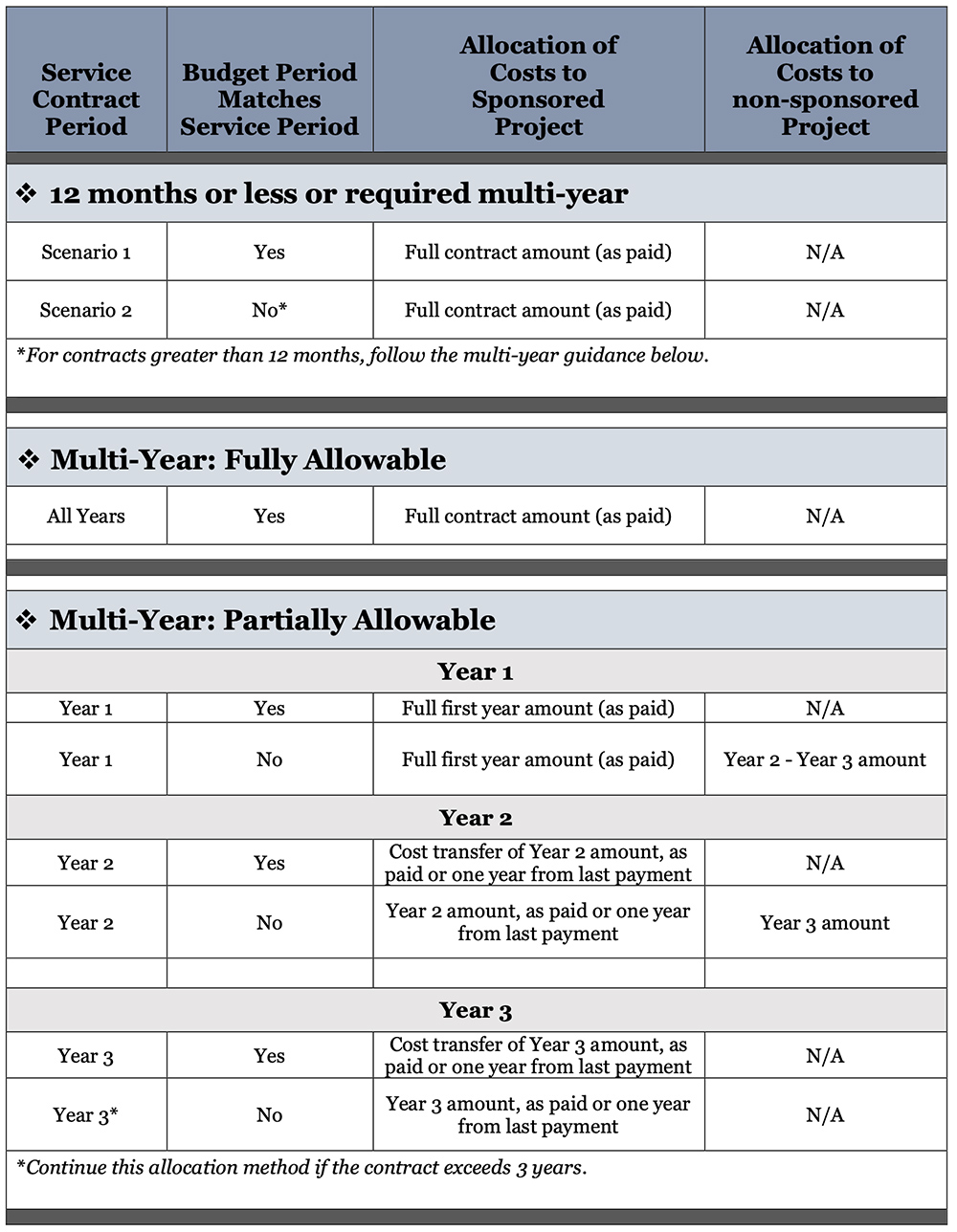
Example Scenarios
Example 1 – Twelve-month contract or less
Invoice received: 03/12/2023
Federal Award: 9021086936
Award period: 03/01/2021-08/31/2025
Maintenance contract period: 04/01/2023-03/31/2024
Annual Maintenance Total: $18,500.00
Accounting: $18,500.00 to award in March 2023 (when invoice received)
Sticking with the main example above, except changing the what ifs below:
What if: invoice received 06/01/2023 and contract period was 06/01/2023-05/31/2024.
Accounting: charge $18,500.00 to award in June 2023
What if: invoice received 06/01/2023 and contract period was 06/25/2023-05/24/2024.
Accounting: charge $18,500.00 to award in June 2023
What if: invoice received 10/01/2024 and contract period was 10/01/2024-09/30/2025.
Accounting: charge 11/12ths of $18,500 to award in October 2024 (award ends 08/31/2025)
Example 2 – Multi-year contract
Invoice received: 05/12/2023
Federal Award: 5021086639
Award period: 07/01/2022-06/30/2026
Maintenance contract period:
Year 1: 04/17/2023- 04/16/2024; $75,250.25
Year 2: 04/17/2024- 04/16/2025; $79,440.48
Year 3: 04/17/2025- 04/16/2026; $80,996.75
Annual Maintenance Total: $235,687.48
Example 2: Accounting- if allowed in full:
Charge full contract amount, $235,687.48, to award in May 2023 (when invoice received) (Allowed in full: justification provided for vital criteria/implications to sponsored project)
Example 2: Accounting- if disallowed in full:
Charge Year 1, $75,250.25 to award in May 2023 (when invoice received)
Charge Years 2-3 total, $160,437.23 to a department discretionary code in May 2023 (when invoice received)
Note: with multi-year contracts, the out years charge must be allocated to a department discretionary purpose code and reallocated to the award yearly corresponding to the service contract year making sure it falls within the award period.
Procedure Details:
OWNER: Research Office
RESPONSIBLE OFFICE: Research Administration
ORIGINATION DATE: July 21, 2023
Procedure Source Email
Procedure: U.S. Department of Commerce
US Bureau of Industry and Security – Export Administration Regulations (EAR)
US Bureau of Industry and Security – Export Administration Regulations (EAR)
These are the unofficial electronic EAR files created by BIS. The legally official text of the EAR is provided via the Federal Register publications. Incorporation of revisions pursuant to Federal Register regulatory publications are completed by BIS within 72 hours to the best of our abilities. While we strive for perfection, we do make mistakes from time to time. You may email any errors that you find.
Procedure Details:
OWNER: US Bureau of Industry and Security
RESPONSIBLE OFFICE: Research Office
Procedure Source
Email